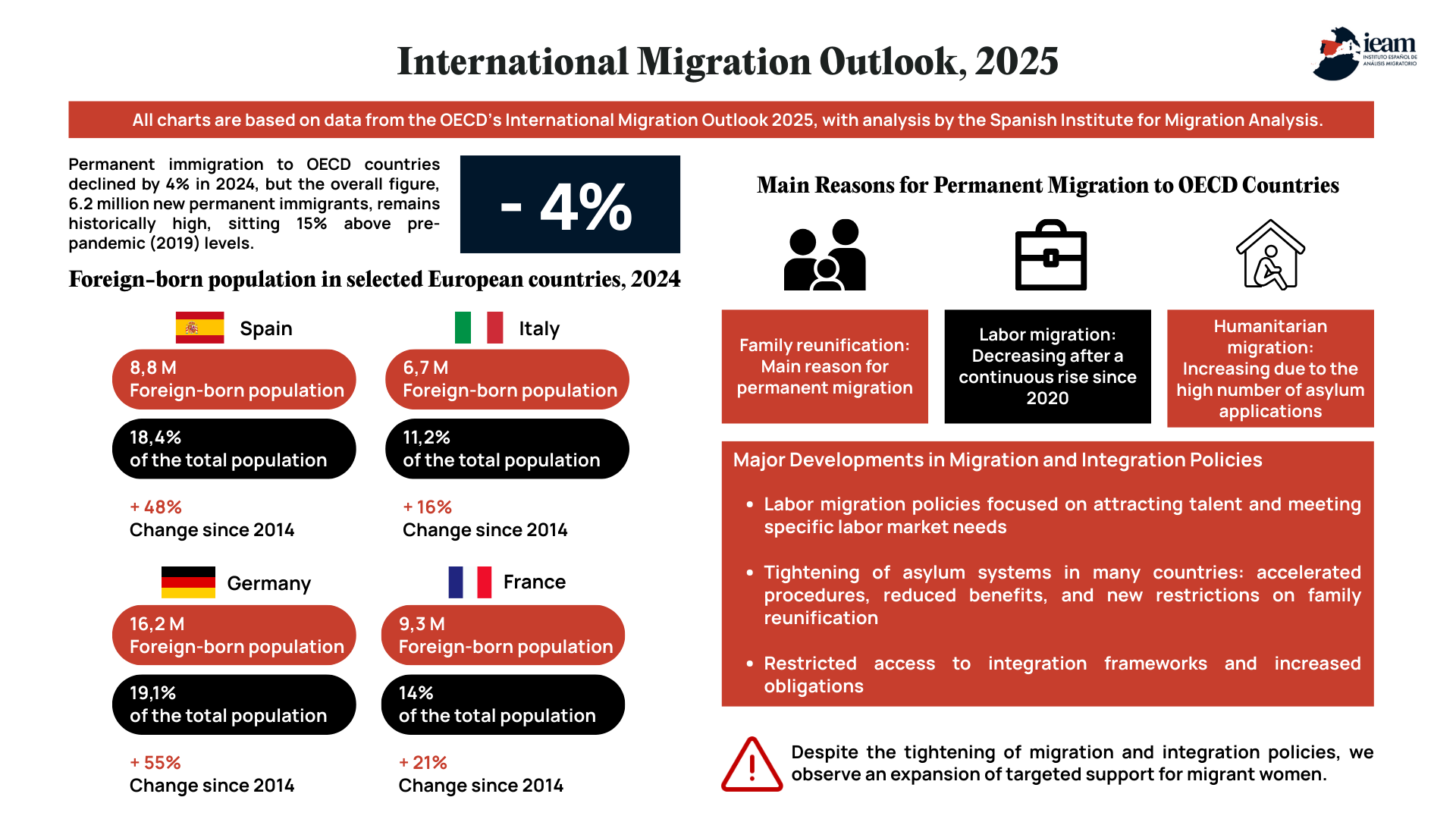
The 2025 edition of the International Migration Outlook highlights a slight decline in permanent immigration to OECD countries in 2024. Despite a 4% decrease, the total number of new permanent immigrants remains historically high, reaching 6.2 million people, which represents a 15% increase compared with levels recorded in 2019, before the pandemic.
Share of the Foreign-Born Population in Four European Countries, 2024
Among the information presented in the report, the IEAM analyzed the share of the foreign-born population in four European countries particularly affected by these migration dynamics: Spain, Italy, Germany, and France.
These changes reflect a sustained migration dynamic, largely driven by family, economic, and humanitarian motives.
Main Reasons for Permanent Migration to OECD Countries
Family reunification remains the primary reason for permanent migration to OECD countries. Labor migration, after a continuous increase since 2020, has slightly declined. At the same time, humanitarian migration is on the rise, linked to the high number of asylum applications.
Major Developments in Migration and Integration Policies
In response to significant migration flows, migration and integration policies in several OECD countries have undergone major reforms. Labor migration policies focus on attracting talent and meeting specific labor market needs. At the same time, many countries have tightened their asylum systems, introducing accelerated procedures, reduced benefits, and new restrictions on family reunification. Access to integration programs has also become more regulated and is accompanied by increased obligations for new arrivals.
Nevertheless, this tightening of policies is accompanied by an expansion of targeted support, particularly for migrant women.
“Despite a 4% decrease, the total number of new permanent immigrants remains historically high, reaching 6.2 million people.”