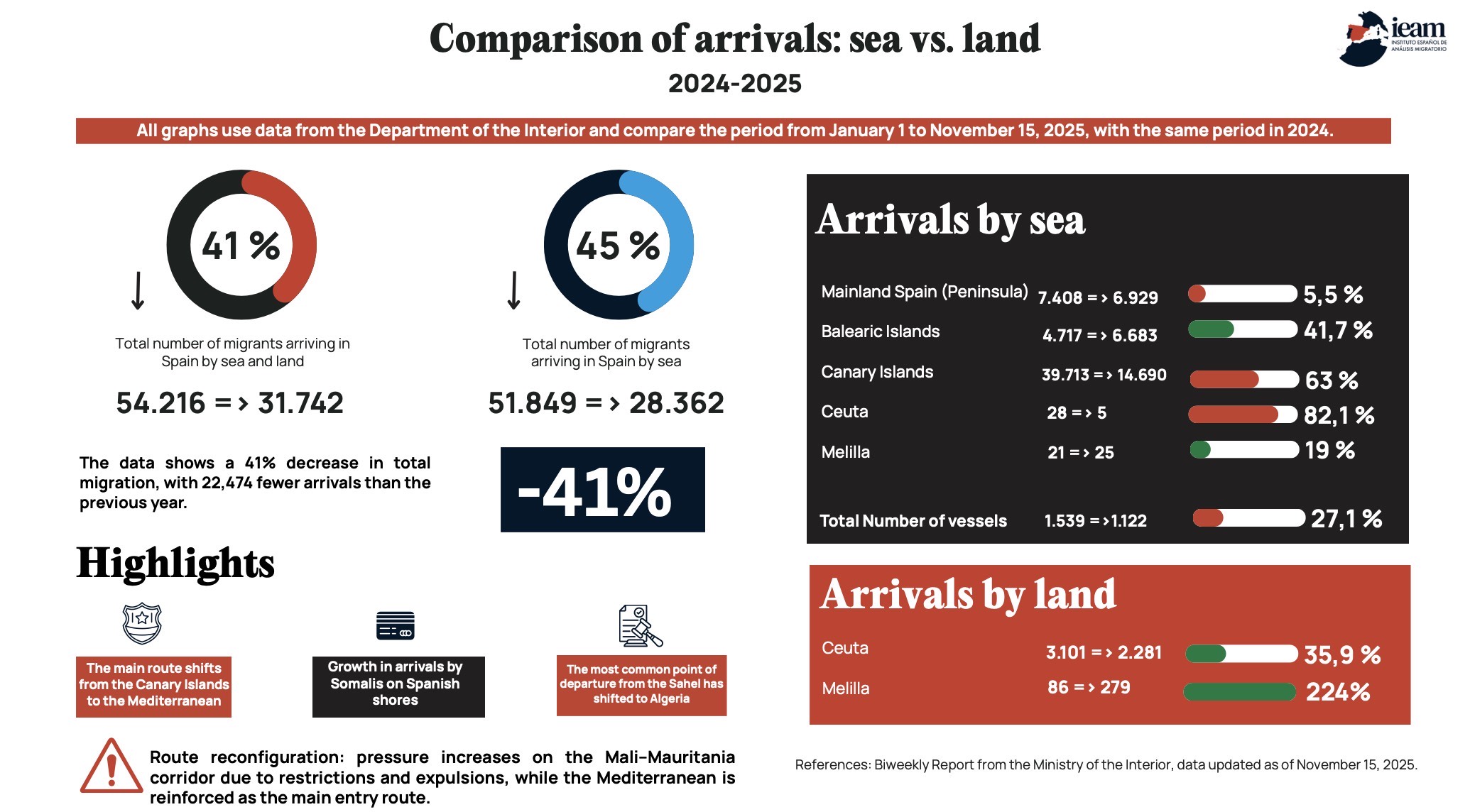
According to the latest data from the Ministry of the Interior, the flow of migrants to Spain fell by 41% between January 1 and November 15, 2025, compared to the same period in 2024: 31,742 people vs. 54,216 (22,474 fewer).
Overall decline, with clear changes by route
By sea, arrivals fell by around 45%: 51,849 → 28,362. The decline is mainly explained by the Canary Islands, which went from 39,713 → 14,690 (-63%).
At the same time, a relative shift towards the Mediterranean is confirmed:
In addition, the total number of vessels has decreased: 1,539 → 1,122 (-27.1%).
By land, the picture is mixed: Ceuta: 3,101 → 2,281 (decrease). Melilla: 86 → 279 (+224%), a very significant increase.
Keys to understanding the reconfiguration
The infographic points to several elements that help to interpret the change:
Conclusion
The provisional balance up to November 15, 2025, reflects a sharp reduction in the total, but also an adaptation of routes: fewer Canary Islands, more signs of the Mediterranean, and a land-based upturn in Melilla that should be closely monitored.
“The total flow is decreasing, but the routes are adjusting: the Mediterranean is gaining weight and the pressure is being redistributed.”