The Atlas of Migration, published by the Publications Office of the European Union, is a reference work providing an overview of migration and a knowledge base for policymakers, stakeholders, businesses, researchers, and the general public.
The 2025 edition offers an analysis based on data on migration movements in the 27 EU Member States and in 171 countries and territories worldwide.
This edition particularly explores the complex links between conflicts and population displacement.
Within the framework of this publication, the Spanish Institute for Migration Analysis (IEAM) has analyzed the main data concerning Spain and Italy.
Forced Displacement on the Rise Worldwide
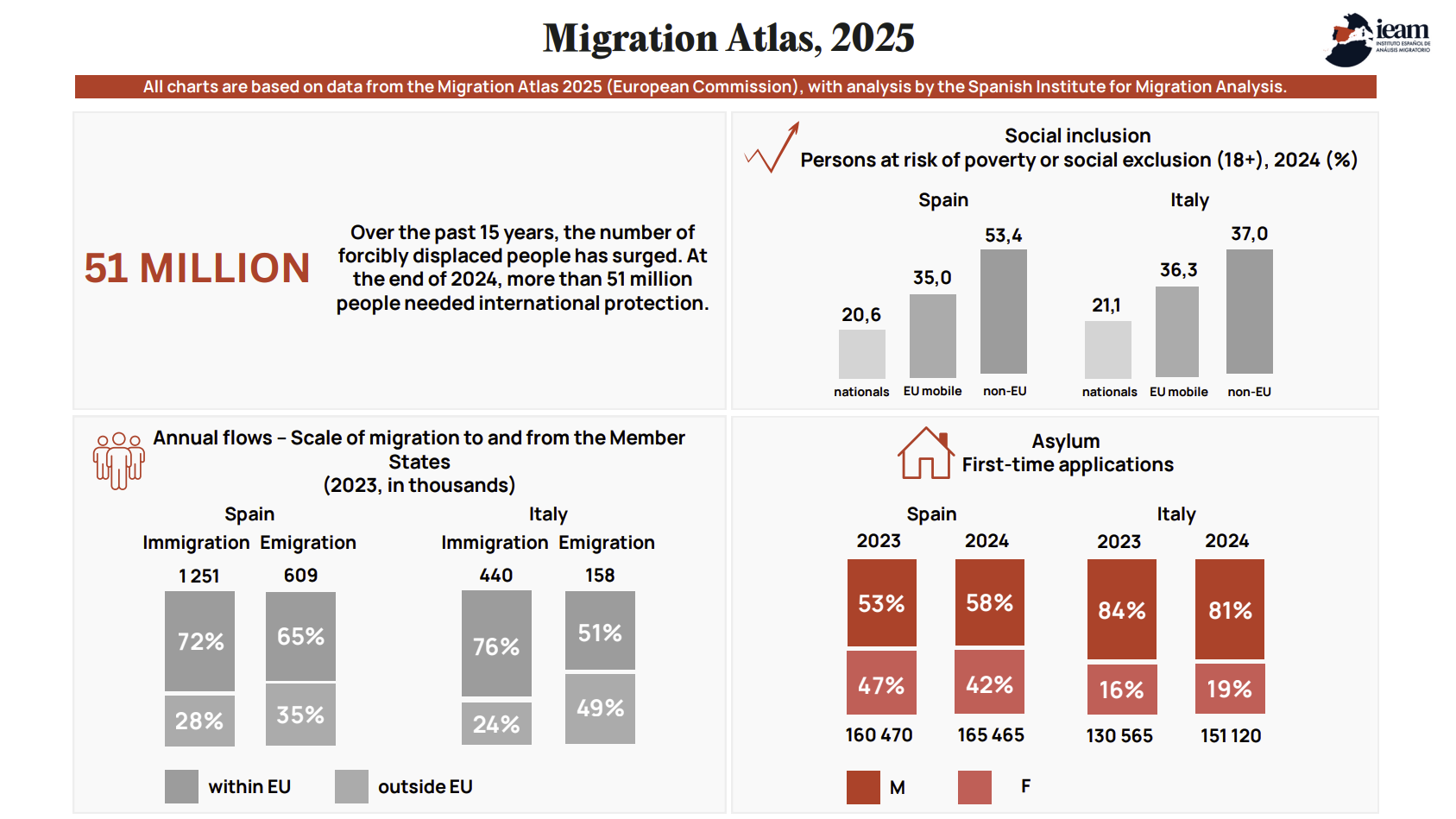
The number of forcibly displaced people has risen sharply over the past 15 years. According to the United Nations, over 51 million people were in need of international protection at the end of 2024.
At the same time, the number of armed conflicts has also increased, reaching over 180 in 2024. Both phenomena are often rooted in state fragility.
Forced displacement has multiple implications: social, environmental, and security-related. Conflicts, in turn, result in human casualties, infrastructure destruction, and institutional breakdown.
Understanding the multidimensional nature of these phenomena and their role in state fragility is essential for designing effective and targeted policies to address these global challenges.
Annual Migration Flows to and from Spain and Italy
In 2023, Spain recorded a high volume of migration flows. The country received 1,251,000 immigrants, of whom 72% came from third countries (outside the EU) and 28% from other Member States. At the same time, 609,000 people left Spain, with 65% moving to countries outside the EU and 35% to other Member States.
Italy shows a similar pattern, but with lower flows. It received 440,000 immigrants, of whom 76% came from countries outside the EU and 24% from other Member States, while 158,000 people emigrated, with an almost balanced distribution between extra-European (51%) and intra-European (49%) destinations.
Asylum Applications: A Continuous Increase
The number of people submitting a first asylum application increased in both countries between 2023 and 2024.
In Spain, the number of first applications rose from 160,470 to 165,465, an increase of nearly 3%. Men remained the majority, accounting for 53% in 2023 and 58% in 2024, while women represented 47% and 42%, respectively.
In Italy, the increase was more pronounced, with 130,565 first applications in 2023 and 151,120 in 2024, an increase of about 16%. Men accounted for an even larger share of applicants, representing 84% in 2023 and 81% in 2024, compared with 16% and 19% for women, respectively.
Social Inclusion: Persistent Inequalities by Origin
Data on social inclusion reveal significant inequalities between nationals and migrant populations.
In Spain, 20.6% of Spaniards are at risk of poverty or social exclusion, compared with 35.0% of nationals from other EU Member States and 53.4% of third-country nationals. The gap is striking: third-country nationals are more than two and a half times more exposed to this risk than Spaniards.
In Italy, the situation shows a similar trend. The risk of poverty or social exclusion affects 21.1% of Italians, 36.3% of nationals from other EU Member States, and 37.0% of third-country nationals.
These figures highlight the persistence of vulnerabilities specific to migrant populations, calling for strengthened, targeted, and effective integration policies.
“Over 51 million people were in need of international protection at the end of 2024.”